Energy
Demand sobriety, local production (solar, wood, micro-hydro), right-sized storage, and repairable equipment. Real energy autonomy starts by reducing demand before adding supply.
Pillar page
Ecology is not just a narrative or a consumer option. It is a way to organize a territory so it remains livable, productive, and supportive over time. This page brings together the principles, concrete pillars, and action levers that Les Fermes de la Vie works on every day.
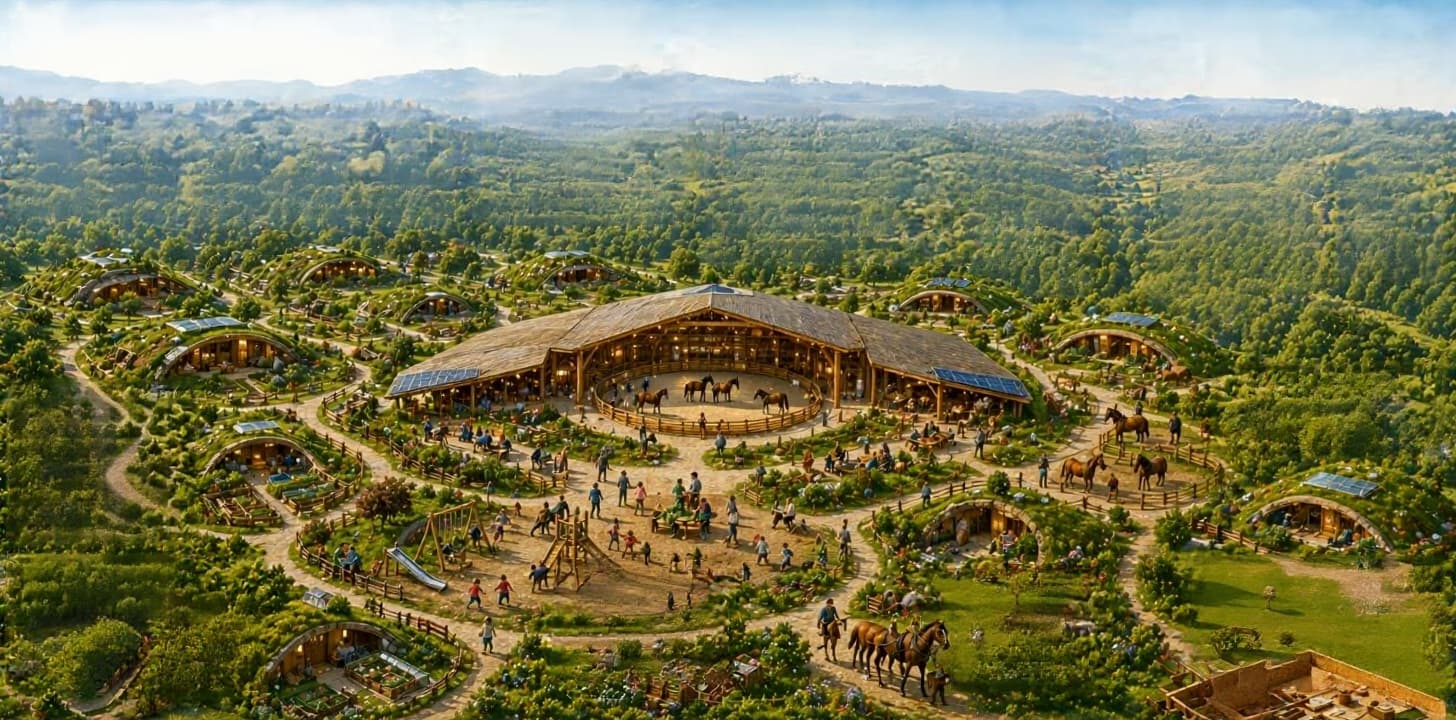
Applied ecology turns ecological principles into concrete, measurable, and reproducible actions at territory scale. It does not stop at observing the state of the world: it builds, tests, and documents local solutions.
In practice, this means producing part of your own energy and food, securing access to water, caring for health and social ties, and passing on the skills that help a territory endure. It is an ecology that is practiced, not proclaimed.
Our approach is grounded in the fragility of today's system: energy, food, and logistics chains are now so tight that even a modest disruption can destabilize them. To understand the project's core choices, read Why this project exists.
An ecology that lasts relies on six essential functions. None is sufficient on its own: they reinforce one another at territory scale.
Demand sobriety, local production (solar, wood, micro-hydro), right-sized storage, and repairable equipment. Real energy autonomy starts by reducing demand before adding supply.
Rain capture, soil infiltration, greywater reuse, household and agricultural sobriety. Water is the first resource to secure if a territory is to remain habitable.
Permaculture, diversified market gardening, peasant livestock, preservation and fermentation. Producing locally what we eat is the condition for durable ecology.
Air, soil, water, food, and social ties shape health. Applied ecology integrates prevention, living environment quality, and access to local care.
Pass on useful skills: grow, care, build, repair, cooperate. Without transmission, no ecology is sustainable.
Ecology holds only when rooted in coherent human organization: mutual aid, shared governance, intergenerational life, celebrations, and rituals.
Applied ecology reaches full power when deployed as a network. The 500 villages program spreads these principles across a mesh of French territories. Each village experiments at its own scale, measures outcomes, and shares lessons with the others.
This network effect delivers three benefits: faster learning (we avoid repeating each other's mistakes), shared technical and human resources, and a body of concrete evidence. To see what daily life in such a village looks like, read Daily life in the village.
Eight pages detail each dimension of applied ecology, with principles, practical action levers, and frequent questions.
Demand sobriety, proportional production, right-sized storage, and repairable equipment: principles and levers for durable territorial energy.
Secure a territory's water: rain capture, infiltration, reuse, and shared governance of water resources.
Living soils, cultivated diversity, preservation and fermentation: produce healthy, resilient food locally.
Air, soil, water, food, and social ties: health emerges as much from the living environment as from healthcare systems.
Learn by doing, connect peasant and scientific knowledge, and learn outdoors through embodied practice.
Decide together at territory scale, manage commons (water, land, energy, knowledge) using proven Ostrom principles.
Think of the village as a robust system: shock absorption, modest redundancy, and interterritorial cooperation.
A way of life that consumes less and connects more: choose intentionally, distinguish needs from desires, and cultivate inexhaustible goods.
Applied ecology is not reserved for project leaders or rural areas. These five levers are accessible to anyone, at any scale.
Every kilowatt-hour not consumed, every liter of water saved, and every kilometer avoided reduces pressure on resources. Sobriety is the most powerful and least expensive tool.
Food, energy, basic care, clothing, tools: relocalizing a meaningful share of these flows reduces dependency and creates rooted jobs.
Grow, preserve, repair, care, build. These skills are acquired by doing. Passing them on to children is a condition of ecological continuity.
No individual transition can hold alone. Cooperatives, associations, village commons, and shared tools make solutions viable at scale.
Measure what is produced, consumed, and saved. Sharing these numbers helps other territories learn faster and avoid mistakes.
Three resources complement this page depending on your focus:
Les Fermes de la Vie is a non-profit association. Our work depends on donated time, skills, and resources. To support financially, visit Donate.